Towering trees that are often several hundred years old have become a life long passion for tree alchemist Torben Hansen.
By Camilla Alfthan, Bo Bedre September 2024
Towering trees that are often several hundred years old have become a life long passion for tree alchemist Torben Hansen.
By Camilla Alfthan, Bo Bedre September 2024
The science of space is travelling with a rocket’s speed. If we’re not on board others will reap the gains, says ESA astronaut Andreas Mogensen en route to the International Space Station.
By Camilla Alfthan, HBL, August 2023
Discreet luxury wrapped in a historic place in the midst of a poetic garden.
By Camilla Alfthan, photos Åsa Liffner, June 2022.
Photos Jacques Toffi
By Camilla Alfthan
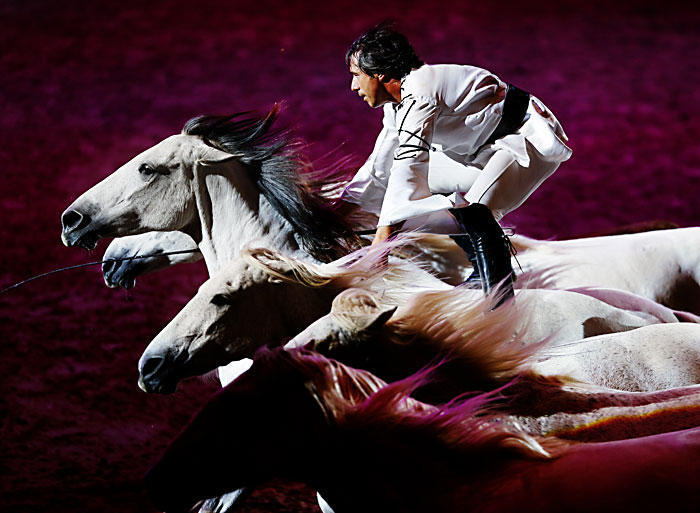
“BASICALLY, I try to show people a part of nature – a stallion, mares and foals, and that is my goal with the shows where horses roam freely,” tells the softly spoken Frenchman over a glass of wine before going in the ring with his show, Horse Music.
The venue is a five star show jumping event with luxury brands strewn all over the place. As a contrast to the lavish surroundings the celebrated horseman is remarkably low key.
Unlike any other rider, Jean Francois Pignon does not work with reins, nor does he use a saddle.
“In my life I was always more or less guided without having to step back and think,” he tells. “It all began one autumn after school when I did’nt have too much time to look after my mares because the evening came fast. I wanted to play with them and didn’t have the time to brush them or put on a saddle. In fact, I learned to ride without a saddle because my father did not have the means to buy one. And I think he thought it was a good way to learn to improve my balance. Afterwards, I found myself working with the horses in the same way.
So without reins, how do you communicate ? What are the brakes and the steering wheel? In the beginning I fell in the trap using words that my father was using, certain words that indicated what the horses had to do. Then I began to observe them and I realized that they don’t communicate like that. Whenever you see a herd move it happens silently. How does the leader tell them, now we move? It’s much more subtle than using words or sounds. Humans are intelligent enough to say that if they go to England it helps to speak English, if they want to talk with me it’s better if they speak a minimum of French and we haven’t thought about the horses in the same way.
With them we speak a human language. I wanted to do the contrary, I wanted to understand the subtleness of the horse.
At first I tried to use a few words that were strong and precise. But a little over a decade ago, I said to myself that I really want to communicate only through movements.
That destabilized me in the beginning because I got used to clicking my tongue like any rider usually does. The first time it didn’t go as well because the horses were used to a certain dialogue between us, to which they responded very well, and when I wanted to go deeper into this subtle langue I felt less sure about myself and the horses were a little bit confused. So we regressed a little.
But I had a new horse, who – unlike the others – did not know his name. All the others would respond to their names but he did not know his, and he was always observing my movements to know what to do and that reassured me. While the others were a little bit confused, he was observing me all the time to read my movements. So I stayed on this track.
Now I have a special relationship with my new horses and I feel that we’ve come further than the others who were used to my voice. I even feel less uncomfortable.
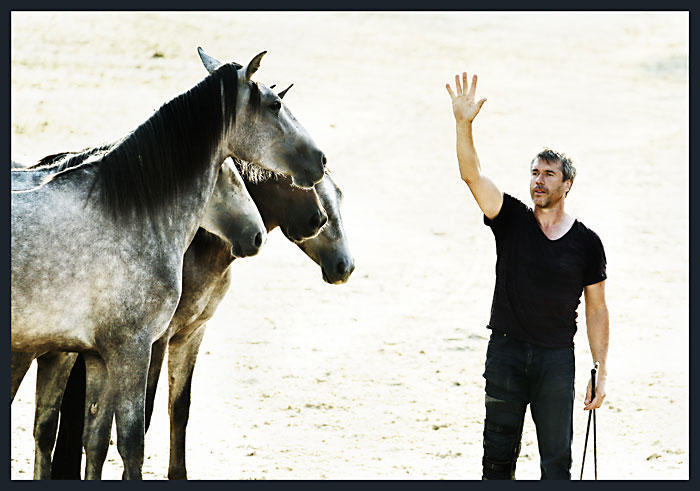
“My dad taught me one thing which is very interesting and important – that the animal must respect you. I find that is the base.”
Is there a hierarchy where you work with the leader of the herd so that the rest will follow him when he follows you? No, you really need to have a relation to each individual horse. Only when you have that you can put them in a group, because once you do so, they have a tendency to slide away because of their natural hierarchy.
So it is only by having a relation with those who are in the lower echelon of the hierarchy that you can make them come next to the dominant horse, that they feel, it is OK because they are protected by me.
So are you their leader ? No, I’m a human being among the horses. But I believe strongly in God and think I was made to be dominant over the animals – especially the horses. So I won’t abuse of this power; I want to respect them and believe in this gift that I was born with.
It began years ago with your mare Gazelle from Camargue. Exactly, I became very interested in horses when I had her, contrary to football where everyone was measuring one another and I needed to prove myself to my friends on the field. With Gazelle I could be very tired and I wasn’t judged by her in any way, she made me feel really good.
Later, when I found faith in God it completely changed my life. He made me understand that loving horses is a good thing but you must not forget to love the humans, too.
So you’re very religious ? No, not religious, certainly not. Because religions are the source of many wars and it’s not very playful. One of the most important phrases in the Bible is to love your neighbour as you love yourself. Religions make war and they often make mistakes. I believe too much in God to be religious.
I really want to love my neighbour, even if he doesn’t think like I do. If theres a lack of respect I will retreat, and the same goes for the horses. The horses that don’t respect me don’t have the right to come next to me. I always put them a little bit behind the others. My goal is to be in harmony with horses and the people.
How long does it take to train the horses? Does it only work with some of them ? It works with all horses which is extraordinary. To make a horse take interest and follow me usually takes one hour.
What do you think about the way the equestrian scene has developed in recent years? The horse adapts very well to all changes. There are many methods and you need everything to make the world. The Bible has taught me about tolerance and love, and everyone has their own ways, if it is jumping bars or racing a horse. I like what others do, too, and I don’t want them to do the same as I.
At l’Ecole Militaire in the heart of Paris, the horses were a relaxed backdrop to Stella McCartney’s latest collection.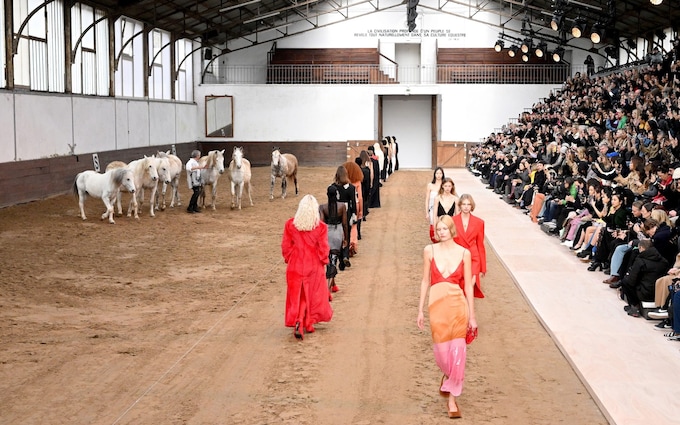
How do you get new ideas to innovate your shows ? Well, it’s funny; my inspiration comes when I clean out boxes when we’re on the road. It’s a manual work that I dont have to think about and my ideas come at that moment and, of course, also when I pray. Whereever I go the language of the horse is universal. We entertain people and I’m also enjoying myself.
Do you ever use tack when at home ? No, the horses are nude. I’m dressed. I feel their warmth against me – we become one.” ©
Designer Alfredo Häberli has created a Swiss Gesamtkunstwerk with the best of the best from his own home country.
By Camilla Alfthan
THE SCENE of this contemporary space is situated in the outskirts of Copenhagen in the residence of the Swiss embassy – a 19th century house facing the sea which is inhabited by Benedikt Wechsler; an ambassador with a penchant for sports and modern design. Dressed in tailored suits and matching bowties he cycles to meetings on a renovated Swiss bicycle from the forties, complete with batteries. A breath of fresh air has also blown through the formerly conservative residence which has been turned into the coolest home on the block. The most iconic piece of furniture is perhaps Ubald Klug’s creme coloured Sofa Terrazza from 1972 which is juxtaposed with an asymmetric coffee table made of fake granite. Its’ hedonistic design of the seventies evokes images of the pop culture of the epoch.
“I received a call from Bern saying that the sofa is not embassy like. I had to reassure them that the ambassador does not smoke pot. If I did not have some humour I would not be doing this,” tells Alfredo Häberli with a laugh.
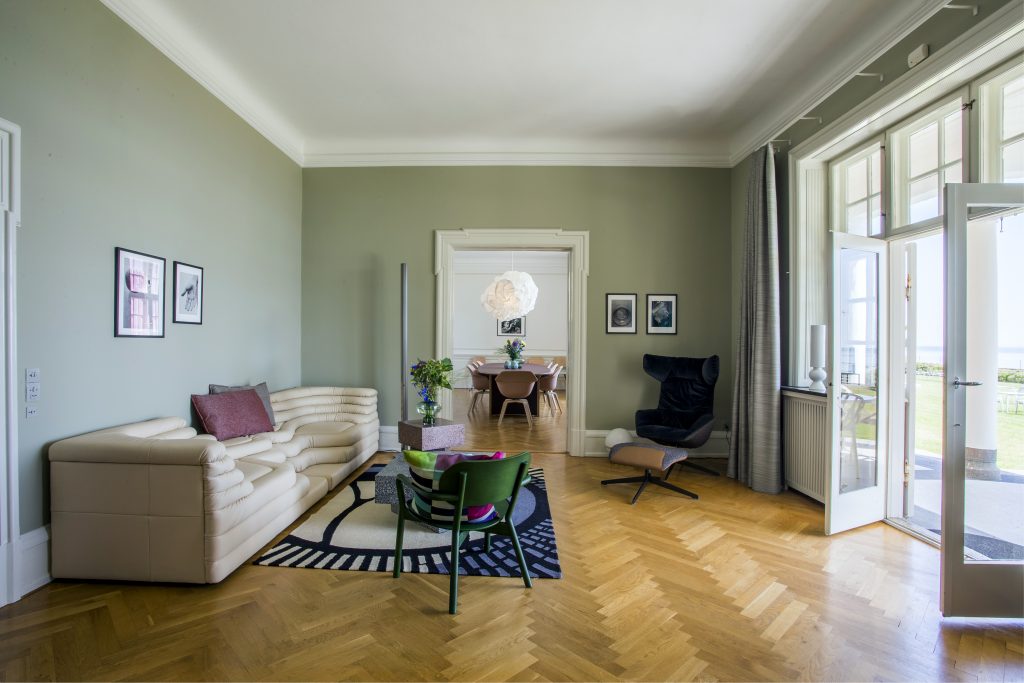
Ubald Klug’s not very embassy like Sofa Terrazza is in for a revival. In the adjoining room Frank O. Gehry’s cloud shaped lamp from Vitra hovers over the dining table.
As the curator of the project he imposed an important rule : All interiors had to be designed or produced in his native Switzerland and of the very best quality.
“I could not buy textiles just because they were inexpensive or choose a furniture cover because it was practical. At first I put a lot of pressure on myself, thinking that the Swiss design had to stand up to the Danish masters such as Wegner and Jacobsen which seemed an impossible task. But then I looked at contemporary design and I realized that Switzerland is doing better than the Danes. Our design is stronger,” he says.
Traditionally, the Swiss style is rational and functional. Colours are muted and the furniture is made using as little material as possible which is often aluminium. “It is a little cold and not very cosy if you don’t count the wooden chalets in the mountains. We don’t have the hygge of Denmark,” Häberli explains.
As a Swiss born in Argentina Alfredo Häberli prefers colors and warm material such as wood and velvet. Instead of the usual white walls, a Scandinavian classic, he painted each room in different pastel colours and picked design favourites from Swiss companies such as Vitra. He also selected things from his own studio including his iconic Moreso chairs and the humouristic Jill Tube which is made of aluminium tubes wrapped in knits.
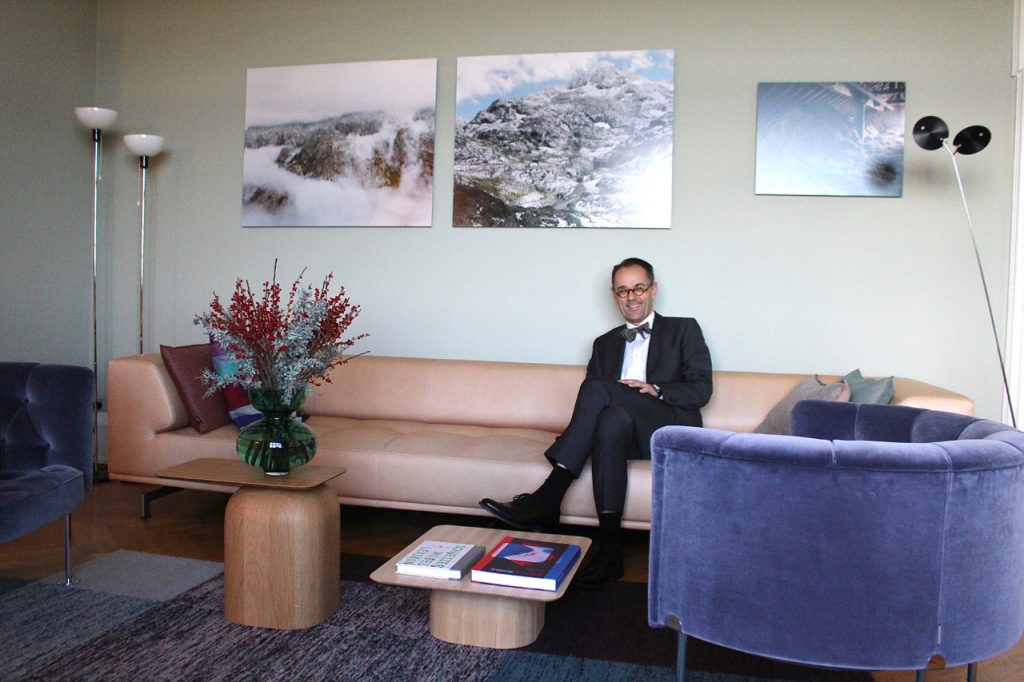
Benedikt Wechsler in his Swiss surroundings which include Häberli’s elegant Moreso chairs and photographs from Fotostiftung Schweiz. Ph. C.Alfthan
As a design project the embassy is a first of its kind.
“Design is a cultural statement. In Denmark and Finland it was always used to market the country but we’re still not quite there though we have good designers and very good architects,” says Häberli who also included the garden in his Gesamtkunstwerk, filling it with Swiss furniture from different epochs. On the terasse there’s Hans Coray’s Landi chair from 1939 with polka dotted holes and another sculptural chair is Loop of 1954. Together with the eternit furniture on the lawn which absorb the heat of the sun they are testaments to the longevity of Swiss ingenuity. ©
Humour, a dash of colour and shoes (for the Swiss brand, Bally) are a part of Alfredo Häberli’s signature designs.
During the Hong Kong riots designers Ed Ng and Terence Ngan were busy creating their new office in Japanese Karuizawa. “To see a mountain with trees and birds instead of tall buildings is the ultimate luxury,” they say.
By Camilla Alfthan, Antik & Auktion, fall 2020.
The Swedes were literally flying at Scandinavia’s largest outdoor meeting where the obstacles were created by the Olympic course builder Sergio Varela.
By Camilla Alfthan, Ridehesten, July 2024
From Ludger’s many likes to Bosty’s endless repertoire.
By Camilla Alfthan
“Design is a cultural statement. In Denmark and Finland it was always used to market the country but we’re still not quite there,” says Alfredo Häberli